6 rules for creative design (after Corita Kent)
I still positively remember the first time I encountered Corita Kent’s “10 Rules” back in college. My life drawing teacher had a monochrome print-out stapled to the wall below the clock, the corners dog-eared by time. I was initially struck by the jumbled, thrumming typesetting of the sentences, and then transfixed by the simple profundity of each rule.
Here they are in full, as both an image and accessible plain text:
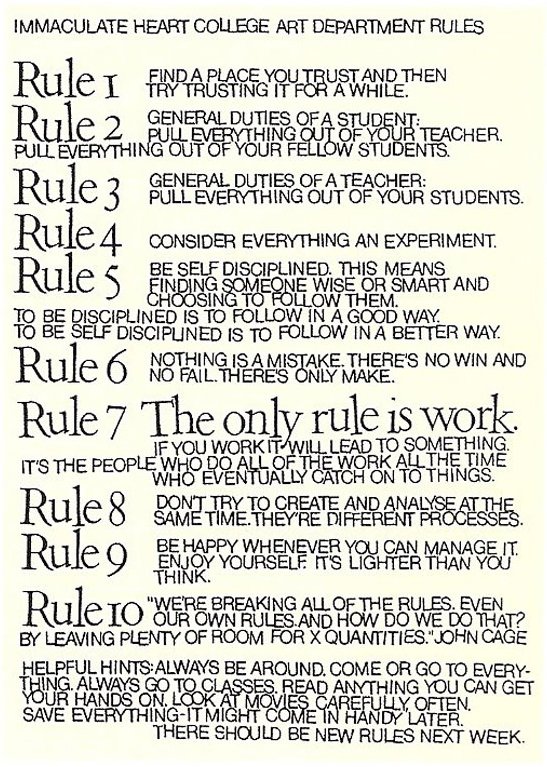
“RULE ONE: Find a place you trust, and then try trusting it for awhile.
RULE TWO: General duties of a student — pull everything out of your teacher; pull everything out of your fellow students.
RULE THREE: General duties of a teacher — pull everything out of your students.
RULE FOUR: Consider everything an experiment.
RULE FIVE: Be self-disciplined — this means finding someone wise or smart and choosing to follow them. To be disciplined is to follow in a good way. To be self-disciplined is to follow in a better way.
RULE SIX: Nothing is a mistake. There’s no win and no fail, there’s only make.
RULE SEVEN: The only rule is work. If you work it will lead to something. It’s the people who do all of the work all of the time who eventually catch on to things.
RULE EIGHT: Don’t try to create and analyze at the same time. They’re different processes.
RULE NINE: Be happy whenever you can manage it. Enjoy yourself. It’s lighter than you think.
RULE TEN: “We’re breaking all the rules. Even our own rules. And how do we do that? By leaving plenty of room for X quantities.” (John Cage)
HINTS: Always be around. Come or go to everything. Always go to classes. Read anything you can get your hands on. Look at movies carefully, often. Save everything — it might come in handy later. There should be new rules next week.”
Upon learning that these were first written in the 1960s, I became a believer in their lasting power. Why? As I see it, none of these rules speak to anything current in technology, media, or culture, nor do they offer rigid prescriptions or rituals for successful outcomes.
They withstand the passage of time because they offer clear guidance on just how to show up in situations where work needs to be done. That’s it. Nothing about what tools to master, or who to become, or what to control.
This has informed myself and my practice immensely; this isn’t about what you can do… it’s who you are when you do it.
Put it another way- what matters is your vulnerable, ever-changing human self in right relation with other humans, the products, systems and communities we come into contact with.
As a product designer with enough innate curiosity to be considered a cat who is working into the year 2026, I’ve been taking into account the rapid, transformative waves of change that AI and generative tools are making around me, which are leaving some fear, doubts, and questions in my professional and personal circles in their wake. When I look back to both these “10 Rules” and my own lived experiences, I’ve come to articulate a set of creative rules to carry me through this era.
These six rules are my attempt to translate Kent’s spirit for design in this era of complexity.

Rule 1Empathy begets understanding
Start with your heart, ears, and eyes. Listen to what users say, don’t say, and can’t yet articulate. The truth will be triangulated.
Empathy is where it all starts. You have to give a damn- or at least train yourself in the art of empathy, like a discipline, to believe that you do- about who you’re designing for and why it matters so much to them. As the late, great artist and director David Lynch said, “Fix your hearts or die.”

Rule 2Prioritize the light
Don't be shady. Clarity is a top design moral.
Visibility and explainability are key drivers for deep trust and high satisfaction.
Time and again, I’ve seen nothing but dissatisfaction, distrust, and disappearing dollars when users are met with deliberately shady design decisions in products. Why keep people in the dark?
When you’re in the light, everything can be examined. From a design perspective, actions that support clarity and understanding bolster feelings of transparency and explainability, which directly lead to confidence and empowerment.

Rule 3Consider all humans
Choose to do what supports the people, whenever possible. Accessibility and inclusion are default requirements.
Metrics are all well and good, and can inform the craft and outcomes, but people define the purpose. Return time and again to user needs. When you make decisions that meet the baseline accessibility levels, you’re being an a11y. Human consideration amplifies the empathy you need to cultivate.
Ask yourself- Who benefits from this decision? Who gets left behind?

Rule 4Delight with purpose
Novelty gets old fast. Delight, when wisely included, can communicate liveliness and purpose in a product’s own unique way.
I love a good Easter egg when designing a product, but the delight in that experience is that it is rare, unexpected, and motivates the user to keep hunting for the next possible surprise. Constantly getting a novel surprise, much like hearing the same joke repeatedly, cheapens the user experience, distracts from completing a task, and increases frustration. Moderating the moments of delight- considering where, when, how, and why to make something delightful- comes from an intuitive place.
Ask yourself- Does this moment of delight feel like the brand of the product would do, say, feel this? What is the line between delight and distraction?

Rule 5Build with care
Every design choice condones or condemns something. Choose what the system and the user are being asked to commit to. Act with responsibility and sustainability.
Always consider to consequences to every ethical decision in a situation. Make sure that the users’ dignity is centered and the system is honored. Show this by building with care and kindness. Sustainability also connects to a product’s long-term clarity, coherence, and scalability.
Ask yourself- If we commit to this, what are the things we are and are not responsible for in the system and for our users?

Rule 6 Always be curious
Consider everything an experiment. Curiosity begets innovation and growth. Protect time and space to play. Celebrate failure as a method of discovery, not justification for punishment.
I’ve saved my favorite rule for last. Curiosity is a natural asset to being any kind of creative person. As Ai Wei Wei said, “Creativity is part of human nature. It can only be untaught.”
When applied to the design process, I’ve honored curiosity this in all the steps- from rigorous research to artistic exploration. I delight in asking questions to myself, my peers, the stakeholders, research participants, and now conversational AI programs. When you’re navigating so much ambiguity in these changing times, curiosity becomes one of your most reliable survival skills.
The space to safely play, fail, and learn from each other and these new tools is crucial to fostering any kind of innovation and growth. I’ve seen brand new design patterns emerge from the conversations my team and I had in a playful icebreaker task of constructing a collage Kaiju from random images in a reporting workshop. You never know where curiosity will take you. As Kent’s rule imparts, be happy whenever, wherever you can manage it. It’s lighter than you think.
Ask yourself- Where does it feel safe to fail and to play? What limits am I putting on myself towards risk and experimentation?
I’ll return to these rules and Corita Kent’s immaculate ones after this era fades into the next. As a person, I like to live with some base set of guidelines that can bend and flow and grow into something more usable and useful, as I also bend and flow with time. Nothing prescriptive nor authoritative- just practical, pragmatic approaches to act as a guide. As long as I remember to design the right relationships I want to have with myself, my peers, the products, people, systems, and communities I come into contact with!
The lesson that I want to impart at the end of this note is: We live in unpredictable times, but we can always choose how we show up. We’re all in the classroom together, metaphorically speaking.
See you again for the new rules, next week.
